SoCoBis

Social Contract and New Ordoliberalism

So far, social contract analysis has remained at the level of theory. However, while this was often sophisticated, its artificiality prevented it from being implemented in practice. We want to bring the social contract analysis down to earth, like the hands reaching for the stars in our team logo. Through this “hands-on” approach we aim to make abstract experiments relevant for policy implementation.

Our aims

SoCoBis aims to explore modern social contract theory and conduct experimental research into the social contract conditions and rules for a basic income society. In so doing, we aim to further develop the tradition of Freiburg ordoliberalism in the direction of “New Ordoliberalism”, as proposed by Prof. Neumärker. This focuses primarily on the sustainability and stability of society. In order to understand the conditions of social sustainability adequately, SoCoBis takes into account aspects of reform economics as well as the economics of conflict and power. The social and economic policy implications of our research findings can be used to provide well-argued justification for the introduction of basic income.

The experimental approach of SoCoBis

SoCoBis differs from other FRIBIS teams in that it puts its theoretical considerations to the test in social laboratory experiments. The objective is to work out socially acceptable conditions for a basic income system. To this end, the investigations are carried out in the Social Contract Lab (SoCoLab), which has been active at the University of Freiburg for over ten years and was awarded the Student Council Prize for its teaching twice (the last time in 2021). In cooperation with the SoCoLab, we examine the relevance of contract theories/contract logics that are rational but reach different conclusions. We also conduct experimental research on social contract sustainability requirements.

Current projects

Currently, SoCoBis is working on two research projects. The first is a publication on the economic-ethical legacy of the philosopher and economist Karl Homann. By means of laboratory experiments, we will compare Homann’s social contract theory with our own model. Secondly, together with our partners, we are seeking funding from the European Commission. We have applied for funding from Horizon Europe under the section “The impact of inequalities on democracy”.

Research Team

Dr. Otto Lehto
is a Finnish philosopher and political economist. His current research with FRIBIS lies in exploring Buchanan’s Demogrant model of UBI, developing Ordoliberal approaches to UBI, and exploring basic income as a tool of freedom.
He recently received his PhD from King’s College London and currently is a postdoctoral research fellow at New York University’s School of Law (2022-2023) and an affiliated Junior Researcher at Freiburg University’s FRIBIS Institute.

Here you see an interview with Otto on Ordoliberalism and Basic Income.

Lives in New York, USA


Clem Davies
is a research associate at the Götz Werner Chair, with current research interests in social contracting and universal basic income, pluralistic economic theory, and German ordoliberalism.

Lives in Freiburg, Germany

Prof. Dr. Bernhard Neumärker
is head of FRIBIS, professor of Economic Policy (Götz Werner Chair) and director of the Department of Economic Policy and Constitutional Economic Theory at the University of Freiburg. Director and Initiators of team SoCoBis.

Lives in Freiburg, Germany

FRIBIS Team Coordinator

Lida Kuang
is a research associate at FRIBIS. Her research currently focuses on the experimental approach to study the justification of UBI as a social contract in laboratory. In addition to this, she is also interested in choices of principles of distributive justice in lab experiments.

Lives in Freiburg, Germany

.

Transfer Team
Daniel Weißbrodt
has been an author and historian in Leipzig since 2013, with a focus on the UBI. Since 2021, he has worked as a project employee at Romano Sumnal e.V., the association of Roma and Sinti in Saxony. He has published significant scientific works, including Economics as an Empirical Social Science. An Inventory (2024) and Die Volkswirtschaftslehre als empirische Sozialwissenschaft. Eine Bestandsaufnahme (2023), both published by Springer Gabler.
Click here to learn more about him and his publications.

Lives in Leipzig, Germany

.
UBI and Gender

Universal Basic Income and Gender (UBIG)

Despite the growing interest in basic income, questions about the design and desirability of a basic income from a feminist perspective remain both marginal and contested. A consensus on what constitutes a “feminist” basic income has not yet been reached, and feminist rationales for or against the idea vary widely.
Against this backdrop, the team’s research aims to provide a conceptual framework for a basic income from a feminist perspective. In doing so, we address a number of questions: what would a basic income as imagined by feminists look like? How, if at all, would such an approach differ from prevailing models? What are the key features or elements that distinguish a feminist basic income proposal? Where might tensions exist, including those stemming from different understandings or approaches to feminism? Finally, what might be the implications of such a framework, for research, policy, activism, and more?

Unconditional Basic Income has the potential to transform society. But historically and to this day, it has been dominated by men and men’s voices that have made their perspective the norm, with women’s voices as complements. We now want to make female and feminist perspectives on the idea of UBI visible.

Publications

Annie Miller, Toru Yamamori, and Almaz Zelleke, “Gender Effects of a Basic Income,” chap. 8 in Malcolm Torry, ed.,The Palgrave International Handbook on Basic Income (Palgrave Macmillan, 2019)

Almaz Zelleke, “Work, Leisure, and Care: A Gender Perspective on the Participation Income,” The Political Quarterly, vol. 89, no. 2 (April–June 2018), pp. 273-79.

Almaz Zelleke, “Feminist Political Theory and the Argument for an Unconditional Basic Income,” Policy and Politics, vol. 39, no. 1 (January 2011), pp. 27-42.

Almaz Zelleke, “Institutionalizing the Universal Caretaker through an Unconditional Basic Income?” Basic Income Studies, 3:3 (December 2008), article 7.

Yamamori, T. (2017). The concept of need in Adam Smith. Cambridge Journal of Economics, 41(2), 327–347.

Yamamori, T. (2018). The concept of need in Amartya Sen: Commentary to the expanded edition of collective choice and social welfare. Ethics and Social Welfare, 12(4), 387–392.

Yamamori, T. (2019). The Smithian ontology of ‘relative poverty’: Revisiting the debate between Amartya Sen and Peter Townsend. Journal of Economic Methodology, 26(1), 70–80.

Yamamori, T. (2020). The intersubjective ontology of need in Carl Menger. Cambridge Journal of Economics, 44(5), 1093–1113.

Yamamori, T. (2022). Is a penny a month basic income? A historiography of the concept of a threshold in basic income. Basic Income Studies, 17(1), 29–51.

Yamamori, T. (2023). Grassroots feminist economic thought: A reconstruction from the working-class women’s liberation movement in 1970s Britain. Research in the History of Economic Thought and Methodology, Volume 41B, forthcoming.

Research Team

Prof. Dr. Almaz Zelleke
is Professor of Practice in Political Science at NYU Shanghai. She specializes in UBI, including gender, political theory and public policy, feminist political theory, and comparative political economy. Her articles on basic income, distributive justice, welfare policy, and feminist political theory have been published in Basic Income Studies, Political Quarterly, Journal of Sociology and Social Welfare, Policy and Politics, Review of Social Economy, Journal of Socio-Economics, and Political y Sociedad.
Lives in NYC, USA

Prof. Dr. Toru Yamamori
is Professor in Economics at Doshisha University, Kyoto, Japan, and co-chair of BIEN working group for the Clarification of Basic Income Definition. He has been working at the intersection of feminist economics, history and philosophy of economics, and oral history. He contributes to international journals such as Cambridge Journal of Economics, Journal of Economic Methodology, Ethics and Social Welfare, and Basic Income Studies. His theoretical research on the concept of need in economics has been recognised with the award of the 2017 K. W. Kapp Prize from the European Association for Evolutionary Political Economy. His oral historical research on the intersectionality between women’s liberation movements and welfare rights movement in the long 1970s Britain won the 2014 Basic Income Studies Essay prize. His historiographical research on the definition of Basic Income won the 2021 Basic Income Studies Prize.
Lives in Kyoto, Japan

Chloe Halpenny (she/her), M.A.
is a PhD student and teaching fellow at Queen’s University, Research Associate at the Social Research and Demonstration Corporation, and Co-Chair and Co-Founder of the Basic Income Canada Youth Network. Her current research focuses on critically exploring policy response to poverty through a feminist disability lens. Previously, she conducted interviews as part of a feminist analysis of the Ontario Basic Income Pilot.
Lives in Ottawa, Canada

Clem Davies, M.S.
is a doctoral candidate in economics at the Götz Werner Chair of Economic Policy and Constitutional Economic Theory. In her PhD she focusses on (critically analyses some of the assumptions underlying economic theory and their policy impacts, particularly applied to Universal Basic Income. Her work focusses on the role of competition in German Ordoliberalism from a feminist economic lens.

Milena Kowalska, Ph.D.
is an economist, researcher at the Department of Corporate and Public Finance at Wroclaw University of Economics and Business, two-term City Councillor in Ostrów Wielkopolski (Poland), board member of a consulting company specialising in advising local governments. Greening the world with One More Tree Foundation.

Maria Franchi
is a doctoral researcher and practitioner of facilitation and community organising, working predominantly as a consultant for a range of social change actors. She is particularly interested in social policy, participatory democracy and intersectional inequalities. Her current PhD research analyses UBI and its potential transformative impacts from a feminist perspective centred on women’s lived experience. She hopes to inform the debate about what might constitute a feminist UBI.

FRIBIS Team Coordinator

Jessica Schulz, M.A.
is a doctoral candidate in educational sciences at FRIBIS. In her dissertation, she deals with the question of what influence an unconditional basic income has on individual learning processes. In empirical investigations, the concepts of leisure and scarcity will be examined in the context of self-regulated learning (SRL), motivation, and decision-making.
Lives in Freiburg, Germany

Contact: jessica.schulz@fribis.uni-freiburg.de

Transferteam – Under construction

UBI Experiments Team (UBI-XT)

UBI Experiments Team (UBI-XT)

Although research and policy interest in UBI has skyrocketed in recent years, resulting in significant increases in funding for UBI pilots, no global platform has yet been established for sharing UBI pilot findings, creating community links across the piloting field and supporting researchers in engaging effectively with policymaker audiences. The UBI Experiments team aims to remedy this by setting up and curating the world’s first global network of UBI piloters.

Next steps

We will begin by launching a monthly newsletter in the Summer of 2023. It will be shared with the UBI piloting community and will feature updates on recent research, policy developments, potential gatherings, publications, and opportunities for collaboration. Then we will host a quarterly online seminar series for piloters to share recent findings and discuss ideas and developments in their work. In late 2023, the team will host a FRIBIS Winter School entitled ‘How to build a pilot’ for students, researchers, and piloters. This will expand on work done in the one-day Summer School at FRIBIS in July this year. Finally, the project will host the world’s first ever conference of UBI piloters at FRIBIS, in Summer 2024.

News

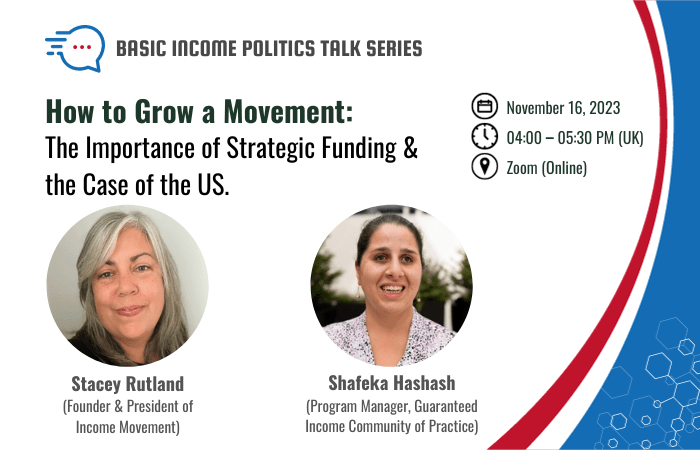
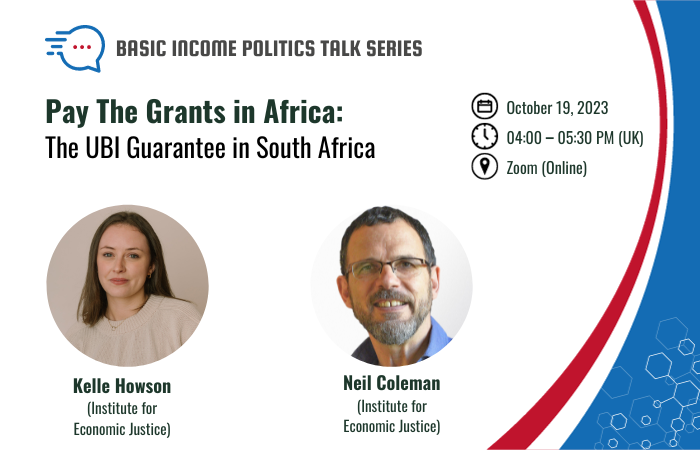
Starting in October 2023 and continuing monthly on every 3rd Thursday, join us for a global exploration of Universal Basic Income (UBI) politics, hosted by the Bath UBI Beacon and Freiburg Institute of Basic Income Studies (FRIBIS), in partnership with the Basic Income Earth Network (BIEN). Experts from around the world will share insights on UBI policy, movement building, and research.

Extended Information

The contemporary politics of universal basic income (UBI) conjures up a paradox. The level, breadth and sophistication of policy attention afforded to UBI is as impressive as it has ever been, with organisations such as the IMF and World Bank engaging with its potential to transform social protection. Experiments and pilots have emerged all over the world in Finland, South Korea, Kenya, Brazil and cities all across the US, while movement building has grown at an impressive rate in many countries. Yet, in terms of tangible policy development, progress has often been slow or non-existent. The introduction of a nationwide UBI scheme still eludes us and many social security systems have seen increasing levels of conditionality and means-testing rather than steps in a more universal direction. It is the perfect time for a global stock-taking of the opportunities and challenges facing UBI advocates, reflecting on policy successes as well as failures, and to ask the important questions needed to develop strategic thinking for building (inter)national movements and getting policy wins.Hosted by the new Bath UBI Beacon and Freiburg Institute of Basic Income Studies (FRIBIS) through their Experiments Team collaboration, this online seminar series will invite people engaged in policy experimenting, movement building, research and activism from every corner of the globe to present their work and experience and reflect on what this means for the politics of basic income. Speakers will cover topics as diverse as experimentation, legislative processes, managing the media, fundraising, coalition building, community outreach and public opinion. The seminars will be open to all who have an interest in basic income and social policy more widely and will have a sizeable Q&A, allowing for discussion and debate. Seminars will be recorded and posted online afterwards.

Events will be scheduled for 90 mins and chaired alternately by Drs. Neil Howard and Joe Chrisp. If the event has a main speaker, presentations will last roughly 20 minutes followed by an hour of Q&A. For panels of 2-3 speakers, presentations will last 10 minutes each followed by an hour Q&A. Featuring panel contributions from Black Sash and Pay the Grants.

📅 Schedule (tentative):

Oct 2023             #PayTheGrants: The Universal Basic Income Guarantee in South Africa.

Nov 2023            How to Grow a Movement: The Importance of Strategic Funding & the Case of the US.

Dec 2023            What has happened in Catalunya?

Jan 2024             Basic Income and Reparations. Movement for Black Lives.

Feb 2024            Basic Income, De-Growth and Climate Politics.

Mar 2024           International Aid and the Politics of Unconditional Cash.

Apr 2024            UBI and UK Party Politics.

May 2024           UBI in CEE countries: Attention, Strategies and Reforms.

Jun 2024             How Much Public Support for Basic Income Is There?

Jul 2024              The Case of Marica in Brazil.

Aug 2024            The Case of India.

Sep 2024            The Policy Impact of Basic Income Experiments.

Oct 2024             The Case of Canada: Ontario, Climate Action Incentive Payment and COVID.

Nov 2024            What Happened in Iran?

Dec 2024            Welsh Pilot Results and Where from Here?

Jan 2025             UBI and Trades Unions.

Research Team

Prof. Jurgen De Wispelaere
is a political theorist turned public policy scholar who has specialised in the political economy of basic income. He is a visiting professor at the Götz Werner Chair of Economic Policy & Constitutional Economic Theory, University of Freiburg. Previously he worked at research institutions in Latvia, Canada, Finland, Spain, Ireland and the UK. He has published extensively on the politics of basic income and is the co-editor of four volumes and is also a founding editor (with Karl Widerquist) of the interdisciplinary journal, Basic Income Studies. He is currently working on two research projects: exploring the policy impact of the recent wave of basic income experiments and examining the role of basic income in emergency situations.
Jurgen is also a big fan of death metal and commutes between Valdivia (Chile) and Freiburg im Breisgau (Germany).

Prof. Karl Widerquist
is a political philosopher at Georgetown University in Qatar. He is the co-founder of the U.S. Basic Income Guarantee (USBIG) Network, which he chaired from 1999 to 2010, before becoming co-chair and later vice-chair of the Basic Income Earth Network (BIEN) until he stepped down in 2017. Widerquist is best known as an advocate of basic income and is a familiar participant at UBI events all around the globe. He has written dozens of articles on the subject and has authored and edited eleven books on the subject, including A Critical Analysis of Basic Income Experiments. He is also an interdisciplinary author of academic publications and has published in journals in fields as diverse as economics, politics, philosophy and anthropology. In 2021 and 2022, he was a visiting professor at the Götz Werner Chair of Economic Policy & Constitutional Economic Theory at the University of Freiburg, Germany. During Widerquist’s stay in Freiburg in 2022 Enno Schmidt filmed an interview with him about the ethics of UBI as well as a public lecture on the pre-history of private property.
Karl Widerquist is based in New Orleans (USA) and Doha (Qatar).

Leah Hamilton MSW, Ph.D.
is Principal Investigator of the Family Economic Policy Lab. She is an Associate Professor of Social Work at Appalachian State University, Senior Fellow at the Jain Family Institute and Faculty Affiliate at the Social Policy Institute of Washington University in St. Louis. She teaches social welfare policy and her research focuses on economic justice and basic income. Her book, Welfare Doesn’t Work: The Promises of Basic Income for a Failed American Safety Net was released in 2020. Currently, Dr. Hamilton is principal investigator for multiple basic/guaranteed income pilots in New York and Georgia. Her work has featured in multiple national publications, including the New York Times, the Wall Street Journal, the Washington Post, CNBC, The Atlantic, Forbes, National Public Radio, and Fast Company. She serves on the Policy Council for the Humanity Forward Foundation and formerly served on the board of the Basic Income Earth Network, BIEN. She was also President of the American Civil Liberties Union in North Carolina.
Dr. Hamilton lives in North Carolina. Click here to follow her on Twitter.

Nika Soon-Shiong
Doctoral Student, University of Oxford; M.A. African Studies, Stanford University; B.A. International Relations, Stanford University. Founder and Executive Director of the Fund for Guaranteed Income (F4GI) – a nonprofit organization launched to re-imagine the social safety net by decoding complex bureaucracy and building community-designed technology solutions that work. F4GI’s mission is to build new policy arenas where those who are intentionally excluded from welfare and economic systems are delivered their rightful share. Nika directed F4GI’s flagship pilot, the Compton Pledge, as well as the Long Beach Pledge, which expands the program across city lines. F4GI administers 12 pilot programs across the United States including the first GI program for currently incarcerated people. She is the Board Chair of One Fair Wage and sits on the board of the Compton Community Development Corporation and Committee to Protect Journalists. Nika is a doctoral candidate at Oxford University, where her research focuses on Aadhaar, universal digital infrastructure, and citizenship in India. Previously, she worked in the President’s Office of the World Bank to establish the Disruptive Technology Initiative.
Nika is based in Oxford, United Kingdom.

FRIBIS-Team-Coordinator

Dr. Neil Howard
is a development anthropologist turned social protection scholar. His work focuses on cash transfers, basic income, and basic income piloting. Currently he is co-directing a pilot in India and a sister pilot in Bangladesh. Both of these combine unconditional cash and community organising across entire slum communities in Hyderabad and Dhaka. Neil is a member of the Executive Committee of the Basic Income Earth Network and is the convenor of the UBI Piloters Network.
He lives in Bath (UK).

Contact: nph28@bath.ac.uk

Transfer Team

Dr. Miriam Laker-Oketta
is a medical doctor and researcher. She is the Research Director of Give Directly, by far the largest venture worldwide to transfer money as a basic income to the poorest households in many countries in Africa, as well as Asia and the USA. Dr. Miriam Laker-Oketta is a 2020-2021 Fellow of the International Women’s Forum’s Executive Leadership Foundation Program of the INSEAD Business School and Harvard Business School. She is director, chairperson and member of the board in numerous organizations and institutes. In addition to other degrees she holds an MAS in Clinical Research, Epidemiology and Biostatistics (University of California) and she has an MSc in Tropical Medicine and International Health (London School of Hygiene). She is the author of numerous other publications. Click here to view her presentation from the FRIBIS Annual Conference 2022.
Dr. Miriam Laker-Oketta lives in Kampala (Uganda).

Dr. Sarath Davala
is chair of BIEN (Basic Income Earth Network) and coordinator of the Indian Network on Basic Income (INBI). He is co-author of the book Basic Income: A Transformative Policy for India. He was the research director of the Madhya Pradesh Basic Income pilot project (2011 to 2014) and the host of the BIEN World Congress in Hyderabad (2019). He currently co-directs WorkFREE, a basic income pilot project in Hyderabad with urban garbage collectors. Simultaneously, Sarath also directs a Basic Income and Care micro pilot project with transgender persons in Hyderabad. Click here to watch Sarath Davala’s lecture at FRIBIS Annual Conference 2022 at the University of Freiburg.
Sarath Davala is based in Hyderabad, India.

UBITrans

UBI and Social-Ecological Transformation (UBITrans)

Universal basic income and the social-ecological transformation: do they go together?

In the face of climate change, increasing social inequality, the rise of new populisms and the spread of COVID-19, unconditional basic income is now discussed more than ever. May universal basic income help to remedy what has been diagnosed as a multidimensional crisis of capitalism? Could basic income put an end to growth-dependency of contemporary capitalist economies and lead towards more sustainable trajectories? Or may it simply reinforce neoliberal growth scenarios and lead to radical individualism?

Our approach and our goals

Given the social and political urgency of the issues at hand, we aim to address these questions and contested issues around the relationship between universal basic income and the social-ecological transformation via a series of talks and interactive debate. This series will integrate perspectives from economics, sociology and psychology as well as from civil society movements and politics.

The series will ask whether universal basic income would enable the (much needed) social-ecological transformation. It will look at both the powers and limitations of a universal basic income to affect the social and cultural transformation of contemporary capitalist societies, while taking account of a variety of potential scenarios from green growth, post-growth to degrowth.

Online lecture series starting as off June 2022

The online series (potentially hybrid later on) will start as off June 2022. Speakers will be announced soon. The series will shed light on the role of the state (e.g. macro-economic policy, financing, the citizen-state relationship, and the acceptance of social-ecological reforms) as well as the role of actors (production and consumption patterns) and subjectivities (habitus transformation) in the process of the social-ecological transformation.

Publications

Ketterer, H. (2021). Living differently? A feminist-Bourdieusian analysis of the transformative power of basic income. The Sociological Review. 69(6):1309-1324. (considered for journal article of the year price in 2021; ranked as “highly commended” article)

Güntert, S., Wehner, T., Mieg, H. (2022). Volunteer work: Organizational, motivational, and cultural contexts of volunteering. Springer Briefs in Psychology. (pp. 50 Swiss militia system)

Ketterer, H. & Becker, K. (2023). Qué falla en la democracia?: un debate entre Klaus Dörre, Nancy Fraser, Stephan Lessenich y Hartmut Rosa. Barcelona: Herder, Editorial.

Schachtschneider, Ulrich 2023: Ecological Eurodividend. Ein Schritt zum Grundeinkommen in Europa. In: Lüdemann,Otto/ Neumärker, Bernhard/ Schachtschneider, Ulrich: Grundeinkommen braucht Europa – Europa braucht Grundeinkommen (Hg.) 2023

Howard, Michael W./Pinto, Jorge/ Schachtschneider, Ulrich 2023: Ecological Effects of Basic Income. In: The Palgrave International Handbook of Basic Income. Palgrave Macmillan UK. 2nd Edition 2023.
Schachtschneider,Ulrich 2023: Grundeinkommen als (große) Transformation. In: Neumärker/Schulz (Eds.): Basic Income and Development, Proceedings of the FRIBIS Annual Conference 2022

Schachtschneider,Ulrich 2022: Grundeinkommen: Ein gastliches Umfeld für Postwachstum? In: Neumärker/Schulz (Eds.): Financial Issues of a Universal Basic Income  Proceedings of the FRIBIS Annual Conference 2021

Schachtschneider,Ulrich 2021: The Ecological Euro-dividend: A Step towards Basic Income in Europe. In Green European Foundation (Ed.): European Green Perspectives on Basic Income Vol.II, 2021

UBITrans Public Seminar Lectures

17th November 2022: Mikael Malmeus - Situating Basic Income In Two Future Post Growth Scenarios

Abstract: How well a universal basic income (UBI) would fit into a post growth economy depends a lot on assumptions about the core characteristics of such an economy. Comparing UBI in a “local self-sufficiency” economy to a UBI in an “automation” economy, we show that the impact of a UBI would differ greatly between these contexts. Our analysis shows that a UBI is less compatible with a labor-intensive local self-sufficiency economy than a capital-intensive, high tech economy. We conclude that the feasibility and attractiveness of a UBI depends greatly on the specific characteristics of the economy.

12th December 2022: Ina Praetorius - Freiheit in Bezogenheit lernen. Ohne BGE - Oder besser: Mit BGE

Abstract: Dass „Freiheit“ nicht die sterile Selbstbezogenheit des „homo oeconomicus“ meint, müssen wir in Zeiten des Klimakollaps sowieso lernen: Alle Menschen sind geboren, verletzlich, sterblich, abhängig von der Natur und voneinander. Das BGE wäre eine große Unterstützung in diesem notwendigen Lernprozess. Denn es nimmt die Angst um die eigene Existenz. Und es befreit dazu, neue freie Formen der Bezogenheit und der Gegenseitigkeit zu erfinden und auszuprobieren.

6th February 2023: Frank Schulz-Nieswandt - Sozialstaatskulturen und Sozialcharakter: Psychodynamische Grundlagen von Solidaritätsverständnissen

Abstract: Wohlwissend, dass der bundesdeutsche Sozialstaat in verschiedenen Teilbereichen unterschiedlichen Gerechtigkeitskonzepten folgt und daher in der kritischen Reflexion einer differenzierten Vorstellung von Solidarität bedarf, wird die Analyse in einem ersten Schritt zugespitzt auf die Idee der unbedingten Solidarität im Lichte anthropologisch fundierter rechtsphilosophischer Überlegungen über eine responsive Gabe, das Gegeben-Sein des Anderen, die Unbedingtheit der Würde und die relationale Autonomie. In einem zweiten Schritt werden die psychodynamischen Grundlagen einer kulturellen Grammatik des Miteinanders als Miteinanderfreiheit in Miteinanderverantwortung skizziert. Mit diesem Blick auf die Herausbildung eines prosozialen Sozialcharakters wird in einem dritten Schritt deutlich, dass eine kritische Theorie der Möglichkeit eines Gestalt-wahren Lebens in einer unwahren Welt nicht ohne Psychoanalyse der Subjektivierungsformen auskommt.


27th February 2023: Ronald Blaschke - Emanzipatorisches Grundeinkommen und Postwachstumsgesellschaft

Abstract: Am Montag, dem 27. Februar 2023, hält Ronald Blaschke einen Abendvortrag zu „Emanzipatorisches Grundeinkommen und Postwachstumsgesellschaft“. Im Vortrag soll begründet werden, warum ein emanzipatorisches Grundeinkommen eine Postwachstumsgesellschaft befördern kann. Dazu werden mehrere Thesen zur Diskussion gestellt. Eingangs erfolgen Begriffsklärungen.

20th April 2023: Alexander De Roo - Grundeinkommen - Immer wichtigerer Bestandteil grüner Politik?

Abstract: Fast alle grünen Parteien in Europa haben sich für eine Art Grundeinkommen ausgesprochen. Schon dreimal war das Grundeinkommen Bestandteil der Verhandlungen bei der Bildung einer Regierung in den Niederlanden. Der Streit um Klimapolitik und Naturschutz wird noch viele Jahre brauchen, um erfolgreich zu sein. Eine Einführung von Grundeinkommen hilft, dem zentralen Anliegen grüner Politik, da die unteren Schichten der Gesellschaft dann keinen finanziellen Stress mehr haben und sich auch grün engagieren würden. Ein aktives Werben für Grundeinkommen durch grüne Parteien ist notwendig um eine Volkspartei zu werden.

11th May 2023: Jurgen De Wispelaere - Basic income as an Eco-Social Policy Instrument? A Preliminary Framework and Comparative Analysis of Policy Alternatives

Abstract: For decades basic income has been hailed as an eco-friendly policy and concurrently Green Parties in Europe and elsewhere are amongst its staunchest political supporters. In recent years, basic income has come under attack from a number of policy competitors that all claim to be the real drivers of eco-social policy reform. These include: participation income, universal basic services, job guarantee programs, and forced reduction (and redistribution) of labour time through four-day work week programs. Despite a number of obvious synergies, each of these policies are typically pitched as direct competitors to the basic income proposal. The eco-social state debate has adopted a strong zero-sum approach in which we are forced to opt for one policy and ditch the others, as opposed to thinking the eco-social state as a policyscape in which a mix of different policies might be the optimal scenario. In this presentation I am more interested in exploring the comparative advantages for each of these proposals. To do so I propose to first set out a framework for the comparative analysis of competing eco-social policy proposals. Next I apply this framework briefly to examine the relative merits of basic income over its main competitors. Finally, I reflect on the need to rethink the debate on eco-social policy reform as a positive-sum game featuring a mix of various policy instruments.

19th June 2023: Philipp Frey - CO2 taxation for a green basic income?

Abstract:

For many years, CO2 taxation has been seen by economists who rely on market-based solutions as a key means of combating climate change. At the same time, it is well known that consumption-based taxes hit households at risk of poverty particularly hard. Thus, taxation that appears to make ecological sense threatens to become yet another inflationary driver, placing an economic burden on those who have contributed and are contributing far less to climate change than wealthy and affluent households. Against this background, the demand to redistribute the revenues from CO2 taxes as a kind of climate money enjoys great popularity. A corresponding design is intended to help reconcile social sustainability and an ecological steering effect. However, it can also be an entry project into an unconditional basic income. The lecture will illustrate the distributional effects of such a CO2 taxation to show that it represents a policy to set massive incentives in the sense of ecological sustainability and at the same time to fight poverty radically on a national, European and global level.

Research Team

Dr. Ulrich Schachtschneider
studied energy engineering, sociology and environmental policies and is working as energy consultant and freelance social scientist. His research fields are social-ecological transformation, sustainability and modern society, and policies of “Degrowth”. He is member of board of Unconditional Basic Income Europe (UBIE) and advocating for an “Ecological Basic Income”. Lives in Oldenburg, Germany.

Hanna Ketterer
is a sociologist based at Jena University. Her research focuses on basic income’s potential to transform the capitalist way of life centred around paid work and employment. In her work, she integrates Bourdieu’s practice theory, feminist perspectives and gift theory. Her phd is based on a multi-sited ethnography on decoupling income from labour examining the day-to-day practices of rentiers, communards and pensioners. Hanna holds a BA in European studies from the University of Maastricht and a
MPhil in Sociology from the University of Cambridge. She has worked at the DG Employment, Social Affairs and Inclusion of the European Commission in Brussels, at the ETH Center for Occupational Studies and at the DFG-research group on post-growth societies at Jena University. She is associated member of the collaborative research centre Structural Change of Property.

Dominik Schröder
is a PhD student at the Götz Werner Professorship at the University of Freiburg and tutor for economic policy. His focus is on the connection between UBI, digitalization and socio-ecological transformation. He has been working on concepts for an integrated, efficient and sustainable energy supply and storage in the Upper Rhine region within the RES-TMO project.

FRIBIS Team Koordinator

Dr. Bianca Blum
is a Post-Doc researcher and Lecturer at the Götz Werner Chair of Economic Policy and Constitutional Economic Theory, University of Freiburg in Germany. Her research interests centre on the political economy of sustainability, rebound effects, empirical method application and experimental design, regulation and taxation as well as the political economy of reforms. She worked on interdisciplinary research projects such as the Suslight project and the RES_TMO project  with focus on energy efficiency improvements and energy consumption.

Transfer Team

Adrienne Goehler
is in series: graduate psychologist | President of the University of Fine Arts in Hamburg | Senator for Science, Research and Culture of Berlin | Curator of the Hauptstadtkulturfonds | Fellow IASS Potsdam. Today she is simultaneously: freelance publicist and curator | theorist and activist Unconditional Basic Income | initiator and artistic director EXAMPLES TO FOLLOW! expeditions in aesthetics and sustainability | Affiliate Fellow at IASS Potsdam

Universal Basic Income Liechtenstein (UBILI)

Universal Basic Income Liechtenstein

The population in the Principality of Liechtenstein, as in most post-industrial countries, is currently confronted with four social issues: Financing old-age provision, rising health care costs, unpaid family work, and climate protection. We investigate whether and how an unconditional basic income (UBI) could be a policy option to implement a sustainable welfare instrument.

The idea of a basic income is not new. It goes back a long way and has proponents in various academic circles and across the political spectrum, in what Atkinson (1995) calls a “rainbow coalition.” For example, Meade (1935, 1990) originated the idea of the social dividend, in which the state is viewed as the economic owner of a nation’s wealth, so it should redistribute the income from that nation’s wealth to every citizen in the form of a social dividend. This idea was taken up by Rhys-Williams (1943) and Friedman (1962, 1968) in the form of a negative income tax (NIT).

In addition to living wage concepts, designs for partial basic incomes have also been developed, which – as in the case of caregiving, for example – aim to recognize and compensate the work of caregivers and provide them with financial support and stability. In Liechtenstein, some elements have already been implemented, such as a form of universal care allowance, as with the Liechtenstein Care Insurance, or time-based currencies for care work, such as the “Zeitpolster”.

We explore how such concepts can be implemented and financed and what effects they have, using microsimulation models as a starting point.

Research Team

Dr. Tanja Kirn, Assistant Professor at the University of Liechtenstein
studied economics at the University of Potsdam and received her PhD there. She develops microsimulation models and uses them to research the interaction of direct and indirect taxation with a focus on behavioral adjustments, work incentives, and incentives for more sustainable consumption behavior. For the FRIBIS team UBILI she analyzes which socio-political and environmental economic implications the introduction of an unconditional basic income would have in Switzerland and the Principality of Liechtenstein.

Dr. Hartmut Hübner
School of Management, University of Salford, UK, 2003 – 2006 Doctoral studies
Dissertation: “The Communicating Company – Towards an alternative theory of corporate communications
Hübner Management GmbH, Vaduz – Managing Director
PAUL-Organizational Development, Munich – Partner
Siemens AG, Financial Services Division, Munich, 02/1999 – 12/2019 Vice President Communications
Deutsche Börse AG, Frankfurt, 10/1995 – 01/1999 Manager Public Relations
Lives in Vaduz, Liechtenstein

Dr. Elisa Streuli 
Lecturer and consultant in management education with a focus on conflict management and consulting at the Zurich University of Applied Sciences
Dr. phil. sociologist, studied sociology, economics, German language and literature and sports at the Universities of Zurich and Basel. “Mediation and Cultural Diversity,” EB Zurich/inmedio Berlin.
Professor at the FHNW and lecturer at the University of Basel as well as several years of experience in professional and management functions in large companies, SMEs and public administration.
Conflict management and consulting, social inequality, leadership, diversity.
Lives in Zurich, Switzerland

FRIBIS Team Coordinator

Enno Schmidt
Patrick Oschwald
studied economics at the University of Freiburg, is coordinator of the team “Universal Basic Income Liechtenstein” (UBILI) and a PhD student at FRIBIS. The focal points of his research are fiscal and distributive effects of a Universal Basic Income, as well as effects on labor supply, which are investigated with the help of microsimulation modelling.

Contact: patrick.oschwald@fribis.uni-freiburg.de

Transfer Team

Markus Härtl
Board member of the association National Campaign UBI Switzerland, active in BGE-Rheintal Co-founder of the German single issue party “Bündnis Grundeinkommen” (deputy Bavarian state chairman and federal board member), president of WLF – Forum für wirtschafts- und gesellschaftspolitische Zukunftsfragen Werdenberg-Liechtenstein, co-founder and co-leader of ARGE LIBIC, board member of “Idee Suisse – Schweizerische Gesellschaft für Ideen- und Innovationsmanagement“.
Candidate for the German Bundestag election, the European election and for the Swiss National Council election.
Speaker for the UBI in German-speaking countries.
Publication of various UBI publications.
Lives in Werdenberg, Switzerland

Wolfgang Jenne
Dipl. Ing. Mechanical Engineering FH.
Active in and with: BGE-Rheintal (member), WLF – Forum für wirtschafts- und gesellschaftspolitische Zukunftsfragen Werdenberg-Liechtenstein (board member), ARGE LIBIC (member).
Lives in Triesenberg, Liechtenstein

Associate / external Team-Member

Dr Rudolf Schär
PhD at ETH Zurich on Infrared and Raman spectroscopy, Switzerland. Postdoctoral Research at Purdue University, West Lafayette, Indiana, USA.
1979-1999 Research projects and management positions at the chemical companies Ciba-Geigy and Novartis in Basel, Switzerland.
IT security officer at the global bank UBS in Zurich, quality management at Swiss Exchange and the pharmaceutical company Cilag, Switzerland.
2006-2009 Lectureships at Zurich University of Applied Sciences Winterthur (ZHW) and Zurich University of Applied Sciences (ZHAW), Wädenswil, Life Sciences.
2011-2018 Participation in the popular initiative for an unconditional basic income (referendum 2016) and in the full money initiative (referendum 2018) for Switzerland.
Member of the Swiss-Palestine Society and the Swiss-Palestine-Network, organiser of the Cafe Palestine and supervisor of an A-level thesis on the future of Palestinian youth.

VATUBI

Value-Added Tax financed Universal Basic Income (VATUBI)

This FRIBIS Team investigates the effects of a change in the tax system on consumption tax/value-added tax (VAT), including the effects on the shadow economy, and VAT as a possibly congenial form of financing the universal basic income (UBI).
Is VAT the tax of the future in an increasingly digital economy and global trade? In a future with constant or even increasing consumption but fewer jobs required for this?

“A tax you can’t run away from” (Prof. Dr. G. Vobruba, Leipzig)

Research Team

Dr. Elisabeth Dreer
Senior Scientist at the Research Institute for Banking of the Johannes Kepler University Linz, Austria
Lives in Pasching, Austria
Prof. Dr. Bernhard Neumärker
Götz Werner Chair for Economic Policy and Constitutional Economic Theory
University of Freiburg, Germany
Lives in Freiburg, Germany

Prof. Dr. Dr.h.c.mult. Friedrich Schneider
former Prof. of the Department of Economic Policy, Research Institute for Banking, Johannes Kepler University of Linz, Austria
Lives in Linz, Austria

Dr. rer. soc. oec. Florian Wakolbinger
Society for Applied Economic Research, Innsbruck, Austria
Lives in Lembach im Mühlkreis, Austria

Transfer Team

Helmo Pape
Banker, Founder of Generation Basic Income, Vienna, Austria
Lives in Vienna, Austria

WEF_FABI

WEF_FABI

The protective function of a UBI against ecological and social vulnerability
The Water-Energy-Food Nexus & Foreign Aid Basic Income Team (WEF_FABI) is investigating to what extent the introduction of a UBI can contribute to strengthening the resilience of social and ecological systems in developing countries. WEF_FABI will investigate, for instance, how communities threatened by land grabbing and climate damage (deforestation, resource exploitation) could be protected from ecological and social vulnerability by the introduction of a UBI. The goal is therefore to better understand the interdependencies between the WEF nexus and the UBI.

The UBI as an instrument of development aid
By introducing a UBI, communities shall become so resilient that they no longer need to have their basic income externally financed in the long run (FABI), but become able to finance it on their own tax bases (self-financed UBI). FABI (cf. Bernhard Neumärker’s concept of “Foreign Aid Basic Income”) then has the effect of a cash-oriented development aid. It will therefore be examined to what extent a basic income can be used as an effective instrument of development aid and what requirements such a context of application places on a basic income mechanism.

WEF_FABI received start-up funding from the FRIAS
WEF_FABI received start-up funding from FRIAS (Freiburg Institute for Advanced Studies), which is designed, among other things, to promote and internationalize cutting-edge research at the University of Freiburg.

Since 2023, WEF-FABi has been a cooperative project between the University of Namibia and FRIBIS / UNI Freiburg.

Research Team

Prof. Dr. Bernhard Neumärker
is head of FRIBIS, professor of Economic Policy (Götz Werner Chair) and director of the Department of Economic Policy and Constitutional Economic Theory at the University of Freiburg. Apart from that, he is also founder of the Basic Income Research Group (BIRG) at Freiburg University. He has been working for many years on questions of social justice, social conflict and state reform from a constitutional perspective. Recently, he has been applying his concepts of “New Ordoliberalism” (recently also called “Progressive Ordoliberalism”) and “Social Sustainability”, which are based on these questions, to the UBI. His contribution to the Water-Energy-Food [WEF] and Foreign-Aid-Basic-Income [FABI] team lies in linking environmental and social sustainability through the implementation of an equitable, sustainable, and resilient social development contract. To this end, he and his team will examine experiments with social FABI contracts in Namibia. The main objective is to find an appropriate governance structure for FABI.

Prof. Dr. Michael Jacobson
is a professor of forest resources in the Department of Ecosystem Science and Management at Penn State University (USA). He carries out extension, research and teaching programs that promote sustainable management of forests and other natural resources. Core activities and interests include forest economics and finance, agroforestry, bioenergy and water-energy-food nexus. He has a significant presence in international activities and teaches forest economics, international forestry, and agroforestry.

Dr. Adalbertus F. Kamanzi
was born in Bukoba, Tanzania, September 1970. He holds a BA in Ethics and Development Studies (2000) and an MA in Development Studies (2001), both from the Uganda Martyrs University, Nkozi, Uganda. He holds a PhD in Development Studies from Radboud University, Nijmegen, the Netherlands (2007). He has worked as a researcher and lecturer at Uganda Martyrs University, the University of Dodoma, and as a senior researcher at the Institute of Rural Development Planning, and as a Visiting and Associate Professor at the Nexus International University. He is currently coordinator of the MA programme in Development Studies at Oshakati Campus, University of Namibia. His research interests and publications include gender issues, e-technologies for development, decoloniality, Ubuntu, and leadership creativity. He uses both qualitative and quantitative approaches. Much as he is a social anthropologist, he has found himself in good scientific company with economists. Over time, he has developed a passion in writing motivational books; he believes that demotivation demotes people’s livelihoods promotion. ​

Dr. Lukas Matati Josua
is a Senior Lecturer in the Department of Higher Education and Lifelong Learning at the University of Namibia (Namibia). He facilitates the Postgraduate Diploma in Higher Education (PDHE). His interest expands into social justice and inclusive development while his research interests cover issues of teaching, assessment, learning, curriculum development, quality assurance, student supervision, use of technology in higher education setting, educational management and leadership, decolonization of the higher education setting.​

Hedvig Mendonca
is a Ph.D. candidate at the Cape Peninsula University of Technology and a lecturer in the computing department at the University of Namibia. She specializes in information systems, business computing, and service design. Her current study is focused on technology to provide equitable access to Justice system services in rural areas. Research interest are include e-technologies for development, service design, mobile technology, health informatics, gender issues, HCI and UX using both qualitative and quantitative approaches, she is also highly interested in equipping young people with self-leadership skills in order to bring about societal transformation. ​

FRIBIS Team Coordinator

Tobias Jäger
studied economics at the University of Freiburg. In his dissertation, he examines basic income in developing countries and deals with the question of what effects the introduction of a basic income in developing countries could have from a conflict-economics perspective.
Lives in Freiburg, Germany

​Contact: tobias.jaeger@fribis.uni-freiburg.de

Transfer Team

Rejitha Nair
is a Lawyer, Researcher and Human Rights Trainer from Gujarat, India. She is a Doctoral candidate at National Academy of Legal Studies and Research (NALSAR), University of Law, Hyderabad and has worked as an Assistant Professor for over six years, teaching human rights and legal theory at Nirma University, Ahmedabad. Her interest lies in understanding the relationship between legal institutions and poverty, focusing majorly on Social Welfare Legislations and Land Laws. In her thesis she is examining whether the law and processes governing technology enabled Direct Benefit transfers in India are tools for empowerment or instruments for exclusion.

Dr. Sarath Davala
is a Lawyer, Researcher and Human Rights Trainer from Gujarat, India. She is a Doctoral candidate at National Academy of Legal Studies and Research (NALSAR), University of Law, Hyderabad and has worked as an Assistant Professor for over six years, teaching human rights and legal theory at Nirma University, Ahmedabad. Her interest lies in understanding the relationship between legal institutions and poverty, focusing majorly on Social Welfare Legislations and Land Laws. In her thesis she is examining whether the law and processes governing technology enabled Direct Benefit transfers in India are tools for empowerment or instruments for exclusion. 

XUBI

XUBI

About XUBI

Expedition Basic Income has set itself the goal of testing which basic income variant would be best suited to our society. This is to be achieved within the framework of a large-scale, nationwide, state-funded pilot project. Expedition Basic Income aims to get this project off the ground by means of direct democracy and subsidiarity. This is why it is collecting signatures all over Germany from people who want to help their town or municipality qualify for the pilot project. As soon as at least 1% of the population in a city or municipality have signed, the local councils of the respective cities and municipalities decide whether to accept the proposal or not. If the proposal is rejected, all eligible voters can vote on the pilot project in a second step. Once the majority votes in favour of the pilot project, the way is paved for the start. The first model projects can commence with the payment of a UBI in 2023.

How do the UBI pilot projects work? 

Within the framework of the pilot project, one out of every 1,000 inhabitants from the participating cities and municipalities will receive a basic income, i.e., they will receive monthly basic income payments for a period of three years. This means that the costs for the implementation of the UBI experiments will remain manageable for states and local authorities. In addition, various ways of financing a UBI can be tested in different cities and municipalities.

UBI activism as a form of educational work

By directly involving citizens in the political implementation of the UBI, Expedition Basic Income has an important educational function. Citizens learn that, far from being powerless in dealing with the state, they can demand, in a legally binding way, that the local governments introduce a UBI.

How can a UBI be financed at the municipal level?

Financing the UBI at the municipal level could be achieved through the federal system of fiscal equalisation (federal state fiscal equalisation, municipal fiscal equalisation) through tax revenue reallocation instead of additional tax collection. This would speed up the implementation. A research position has been established at FRIBIS to investigate the possibilities. At the same time, fiscal equalisation could be a means of finding out whether value-added tax or income tax revenues should be used to finance basic income.

How does FRIBIS support the Expedition?

The FRIBIS team Expedition Basic Income (XUBI), which consists mainly of founding members of Expedition Basic Income, is supported by FRIBIS in several ways. FRIBIS offers the possibility of establishing networks with international experts from a number of the expedition team on financing issues, the design of the pilot projects and the processing and evaluation of data collected during the pilot project.

In this video, Valentin Schagerl and Joy Ponader, activists of the Expedition, explain what their project is all about.

Research Team

Laura Bämswig

Julia Baumhauer
Ethnologist
Project evaluation and research among others for the Gesellschaft für Internationale Zusammenarbeit (GIZ)
Magister Ethnologie (Freie Universität Berlin and Martin-Luther-Universität Halle-Wittenberg)
Focus on Law & Economy
Lives in Berlin, Germany

Jürgen Schupp

Prof. Dr. Jürgen Schupp
Professor at the Institute of Sociology at the Freie Universität Berlin and researcher at the German Institute for Economic Research (DIW Berlin).
Main areas of research: Empirical social research, social indicators, social structure and social inequality.
Lives in Berlin, Germany

Jürgen Schupp

Simon März
studied economics at the University of Bayreuth, the University of Cape Town and the Albert-Ludwigs-Universität Freiburg. He is part of the Expedition Basic Income team and works closely with the NGO Expedition Basic Income. His dissertation deals with the implementation of UBI pilot projects at municipal level in Germany and their financing through equalization mechanisms of the federal state financial equalization system.
Lives in Freiburg, Germany

Jürgen Schupp

Prof. Hanna Schwander
is a full professor and chair of political sociology and social policy at Humboldt-Universität zu Berlin. Located at the intersection between comparative politics, political sociology, and political economy, her research is guided by her interest in how structural changes such as inequality, welfare state changes and climate change affect various aspects of the democratic process. Among others, her research has been published in Journal of Politics, Political Science Research and Methods, Governance & Regulation, and Oxford University Press.
Lives in Berlin (Germany)

Jürgen Schupp

Prof. Swen Hutter
is Director of the Center for Civil Society Research and Lichtenberg Professor of Political Sociology at Freie Universität Berlin. His research focuses on the intersection of political sociology and comparative politics, with particular emphasis on analyzing mobilization dynamics and political conflicts in European democracies. Together with Prof. Dr. Hanna Schwander and Dr. Bastian Becker, he leads the research project monitoring the “Hamburg Tests Basic Income” campaign, studying how mobilization for radical reforms is achieved and how attitudes toward UBI evolve over time. Before moving to Berlin in fall 2018, he was a Research Fellow and Max Weber Fellow at the European University Institute in Florence, Italy, and a research associate at the University of Munich.
Lives in Berlin (Germany)

Jürgen Schupp

Bastian Becker
is a Postdoctoral Researcher at the Institute for Social Sciences, Humboldt-University of Berlin. He received a PhD in Political Science from Central European University and held postdoctoral positions at the University of Bremen and Bard College Berlin. His main research interest lies in the politics of inequality, redistribution, and development, whereby he draws on comparative as well as behavioral approaches. His work has among others been published in Political Science Research and Methods, Social Science Research, and World Development.
Lives in Berlin (Germany)

Transfer Team

Joy Ponader
Founder & campaign strategist
Among other things co-founding of Mein-Grundeinkommen and Sanktionsfrei as well as the Basic Income Initiative Munich, co-organiser of several basic income congresses.
Joy Ponader has been actively involved with the topic of basic income for 14 years
Lives in Berlin, Germany